

Why a Security Patrol Robot From House of Robotics Goes Beyond CCTV in Facility Protection

Updated: 1 day ago
Security teams are being asked to cover more ground with fewer people, and fixed cameras alone cannot keep up. That pressure is why a security patrol robot has moved from a novelty into real physical security planning. A security patrol robot moves through a property, monitors conditions in real time, and flags issues before they escalate, reaching the blind spots static cameras were never built to cover.
House of Robotics deploys this technology across Canadian facilities and handles the assessment, mapping, setup, and ongoing support behind it. For properties dealing with growing footprints, overnight staffing gaps, or repetitive patrol routes, the case keeps getting stronger.
What a Security Patrol Robot Offers Over Traditional Surveillance
For decades, CCTV has been the backbone of physical security. Cameras help organizations monitor facilities, investigate incidents, and deter criminal activity. Across campuses, commercial properties, industrial sites, and public spaces, video surveillance remains part of every serious security program.
Today's problems ask for more than a recording of what already happened. Facilities are getting larger. Labour shortages continue to affect security operations. Expectations around response times, situational awareness, and early risk detection keep rising.
A camera can capture an event. It cannot walk over and investigate it.
That gap is why organizations across Canada are adding a security patrol robot to their security strategy. House of Robotics works with facility and security leaders who have reached the point where adding cameras stops solving the problem, and the full platform behind those deployments is set out on the Patrol Bot page.
→ Curious where your current camera coverage actually stops? Talk to House of Robotics about your property.
What is a security patrol robot?
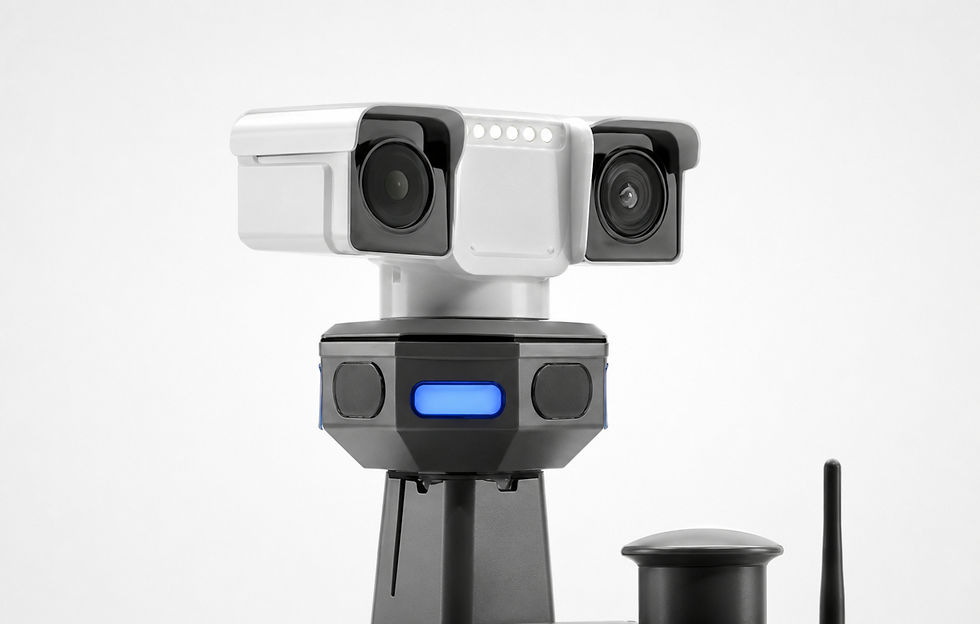
A security patrol robot is a self navigating machine that patrols a property on its own, using artificial intelligence, LiDAR, and HD or thermal cameras to monitor for threats and unusual activity. It follows a mapped route on a set schedule, covers ground a fixed setup cannot reach, and flags anything worth a closer look while it is still happening rather than afterward.
The limits of traditional CCTV without a security patrol robot
CCTV gives real visibility, with one limit that never goes away. A camera never leaves its mounting point. Every lens has a fixed field of view, and anything outside it becomes a blind spot unless another camera is installed.
For large properties, full coverage can mean dozens or hundreds of cameras. Colleges and universities, industrial plants, warehouses, event venues, commercial campuses, municipal properties, and parking facilities all run into the same math. Even after the install, someone still has to watch multiple screens at once, and during busy periods events get missed. Often the footage is only reviewed once an incident has happened.
More cameras add installation cost, maintenance, storage, and monitoring complexity without solving mobility. A security patrol robot is built for exactly that gap, which is why House of Robotics starts every conversation with where coverage is failing rather than with hardware.
→ Tired of adding cameras that still leave gaps? Ask House of Robotics for a coverage review
How House of Robotics Turns Passive Surveillance Into Active Security
A security patrol robot introduces a layer of protection that cameras cannot provide on their own. Instead of waiting for something to happen inside a fixed field of view, the robot moves through the property and inspects the environment continuously.
The technology doing that work combines artificial intelligence, LiDAR navigation, HD and thermal imaging, computer vision, environmental sensors, and autonomous obstacle avoidance. Patrols run without a person steering them, and operational information comes back live rather than being pulled from an archive days later.
House of Robotics treats that shift as an operational change rather than a hardware purchase. Routes are mapped around the areas where risk actually sits, whether that is a back lot, a loading dock, a parking structure, or a perimeter fence line. Alerting is configured around what a specific security team needs to know at two in the morning, not around a generic default. That is the difference between a robot that drives around a property and a security patrol robot that changes how a site is protected.
→ Ready to move from recorded footage to real time awareness? Speak with House of Robotics.

Comparing CCTV and a Security Patrol Robot Side by Side
CCTV does certain things better than anything else. It watches fixed locations without interruption, records evidence, supports investigations, and keeps constant observation on entrances and sensitive areas.
A security patrol robot adds what a fixed camera structurally cannot. Mobile patrols across large properties, AI event detection, thermal monitoring, two way communication, environmental sensing, automated inspections, live alerts, and patrol schedules that run the same way every single night.
Used together, cameras and a security patrol robot cover far more of a property than either does alone. House of Robotics designs deployments around the CCTV a facility already owns, so the existing investment keeps working and the robot fills what it was never able to reach. Facilities comparing options often find it useful to read how a genuine autonomous patrol robot differs from systems that still depend on an operator.
→ Want a clear picture of how a security patrol robot would sit alongside your current system? Book a walkthrough with House of Robotics.
The House of Robotics Patrol Bot, a Security Patrol Robot Built for Canadian Sites
The Patrol Bot was designed to help organizations modernize physical security while taking pressure off frontline security personnel. It operates autonomously, following predefined patrol routes and moving safely around pedestrians, vehicles, and unexpected obstacles using laser SLAM mapping and obstacle detection.
Whether it is deployed at a college campus, industrial site, parking lot, logistics centre, or public venue, it provides continuous visibility through the day and overnight.
Key capabilities of the House of Robotics security patrol robot
This security patrol robot continuously patrols predefined routes while streaming and recording live HD video. It provides 360 degree monitoring with multi sensor integration across LiDAR, ultrasonic, and infrared, identifies anomalies and unusual activity through AI powered detection, and sends real time alerts straight to a phone or a monitoring station.
Two way audio supports both visitor assistance and intruder warnings. Recognition of unauthorized vehicles and faces is available depending on deployment configuration and applicable privacy regulations. Event logs, patrol analytics, and historical data give security managers a record of every round rather than a gap in the log. The build is weather resistant and made for Canadian outdoor conditions, and operation runs around the clock with automatic charging between patrols.
→ Want to see what this security patrol robot does on a live site? Book a Patrol Bot pilot with House of Robotics.
When Facilities Should Bring In a Security Patrol Robot
There is no single moment when every facility needs one. It depends on how a property is used, how it is staffed, and where the current setup is straining. A few patterns show up repeatedly before organizations move.
The property has outgrown fixed camera coverage
Cameras work well when a facility is compact and every important area sits within a lens. As campuses, industrial sites, and logistics yards expand, full coverage starts to mean dozens or hundreds of additional cameras, each adding installation, storage, and monitoring cost. When adding more cameras stops being a realistic answer, a security patrol robot is worth evaluating.
Security teams are stretched thin, especially overnight
Staffing is one of the most common reasons facilities look into this technology. Employment and Social Development Canada's occupational projections for security guards and related security service occupations estimate that roughly 72% of job openings between 2024 and 2033 will come from replacement demand rather than new positions, with retirements driving about three quarters of that.
Much of the hiring pressure comes from backfilling experienced officers who leave the field. A security patrol robot holds a consistent presence through the hours that are hardest to staff, without adding headcount.
Patrols are repetitive and pulling staff from higher value work
If security personnel spend most of a shift walking the same perimeter loop or checking the same parking structure, that is time not spent on incident response, visitor interaction, or judgment calls that need a person. A security patrol robot is built to absorb that scheduled, repetitive work.
Incident reports keep citing blind spots
When post incident reviews repeatedly point to areas outside camera range, a back lot, a construction zone, an outdoor storage yard, mobility is the missing piece rather than more fixed points. House of Robotics maps patrol routes directly against those documented gaps during the site assessment.
The facility needs more than security alone
Some organizations adopt a security patrol robot because the same patrols can capture thermal readings, monitor temperature sensitive storage, or flag equipment issues along the way. Where recurring inspection needs already exist, that added operational value often decides the business case.
The facility is planning for growth
Others bring in a security patrol robot proactively, because they are scaling and want security coverage that expands with the property instead of triggering a fresh camera installation project every time. Coverage can scale across one site or a hundred, coordinated from a single dashboard, with units added without hiring and training rounds.
→ Recognize your facility in any of these patterns? Start a conversation with House of Robotics.

How House of Robotics Deploys a Security Patrol Robot
Buying hardware is the easy part. Making it perform on a real property is where most technology projects stall, and that is where House of Robotics does its work.
Every engagement starts with a consultation. The team walks the site, listens to what is actually going wrong, and maps patrol routes around the highest risk zones rather than around what is convenient to cover. Setup and training follow, including installation, system configuration, charging dock placement, integration with existing security infrastructure, and operator onboarding so the people using the system are confident from the first shift.
Once the security patrol robot goes live, support continues through maintenance, software updates, and performance monitoring, with patrol data reviewed so routes and alerting improve over time. No in house robotics team is required at any stage. Organizations that want to test the fit before committing can start with a pilot and see how the technology performs in their own environment.
→ Want to know what deployment would look like on your site? Ask House of Robotics for a site assessment.
Industries House of Robotics Serves With a Security Patrol Robot
This technology earns its keep wherever security teams cover large areas or repeat the same rounds. House of Robotics works across the industries where coverage gaps cost real money.
Warehouses, distribution centres, and logistics hubs use a security patrol robot for perimeter and yard patrols, loading dock visibility, and overnight alerting across large footprints.
Property management companies and condo operators deploy it through parking garages, lobbies, and perimeters where overnight patrols have been inconsistent and guard contract costs keep climbing. Universities, colleges, and schools use it across campus grounds, residence buildings, and parking lots during off hours. Hotels and hospitality operators apply it to lobby and back of house rounds plus parking coverage, with two way voice for guest assistance.
Retail and shopping centres use it for floor and parking patrols with full video documentation for incident review. Stadiums, parks, and public venues rely on wide area patrols and perimeter monitoring that scale on event days without adding headcount.
Construction sites use it against material and equipment theft, where overnight security options have always been limited. Municipalities apply it to transit facilities, civic buildings, and recreation spaces where budgets are tight and public accountability is high.
→ Not sure how a security patrol robot fits your sector? Ask House of Robotics about your industry.
Where House of Robotics Deploys a Security Patrol Robot Across Canada
House of Robotics is headquartered in Toronto and operated by a Canadian team, deploying across commercial and institutional environments Canada wide. Operating here takes more than importing a machine built for a milder climate and a different regulatory environment.
Every solution is aligned with Canadian regulatory standards including CSA and ISED, institutional procurement requirements, and the privacy and data protection expectations that come with recording video on a property where people live, study, shop, or work. Canadian data residency is part of how deployments are structured, particularly for municipal and public sector clients.
Weather is the other piece. A security patrol robot that only performs in fair conditions would leave the same gaps it was brought in to close, so the Patrol Bot is built for rain, snow, and the temperature swings that come with a Canadian year.
→ Want to know how a security patrol robot handles conditions at your location? Contact the House of Robotics team.

A Security Patrol Robot That Supports Your Existing Security Team
One of the most persistent misconceptions about this technology is that it replaces security officers. It does not, and House of Robotics does not position it that way.
The strongest deployments use a security patrol robot to handle routine patrols, repetitive inspections, and continuous monitoring, which frees security personnel to focus on incidents that need human judgment and direct intervention. The robot handles the perimeter loop at three in the morning. The officer handles the conversation, the escalation, and the decision.
Consider the Patrol Bot another member of the security team, one that never gets tired, never skips a scheduled round, and keeps feeding information back to operators. Facilities weighing the staffing side of this often find it helpful to read how a robot security guard compares with traditional guard coverage on cost and consistency.
→ Want to strengthen your security team rather than reduce it? Talk it through with House of Robotics.
The Future of Physical Security With House of Robotics
Physical security is moving from simple surveillance toward data driven operations.
Organizations no longer want only recorded video. They want usable information while a situation is still developing.
Combining existing CCTV with a security patrol robot gives facilities broader coverage, faster incident awareness, consistent patrol execution, and a documented record of what happened and when. House of Robotics helps organizations across Canada make that move without it becoming a technology project that outgrows the problem it was meant to solve.
→ Thinking about where your security program should be in two years? Map it out with House of Robotics.
Modernizing Facility Protection With a Security Patrol Robot
Coverage gaps, overnight staffing pressure, and repetitive patrol routes are not going to resolve on their own, and adding cameras has stopped being an answer for large properties. A security patrol robot extends existing security infrastructure with mobility, AI detection, and real time awareness, working alongside the team already in place.
House of Robotics handles the site assessment, route mapping, installation, training, and ongoing support that make a deployment perform on a real property rather than in a demonstration. Whether the site is a campus, an industrial facility, a commercial property, or a public venue, the goal stays the same, which is better coverage for the team already protecting it.
→ Ready to see what a security patrol robot would do at your facility? Book a demonstration with House of Robotics.
→ Want to follow new deployments and product updates? Connect with House of Robotics on LinkedIn.
Common Questions About a Security Patrol Robot From House of Robotics
What is a security patrol robot and how does House of Robotics deploy one?
A security patrol robot is a self navigating machine that patrols a facility without an operator steering it, using artificial intelligence, LiDAR navigation, and HD and thermal imaging to scan for threats and unusual activity along a mapped route. House of Robotics deploys one by walking the property first, identifying where coverage is currently failing, and mapping patrol routes around those zones. Installation, configuration, charging dock placement, and operator training follow, so the system performs from the first shift rather than after months of trial and error.
How does a House of Robotics security patrol robot work with existing CCTV systems?
It extends them. A camera system is excellent at watching fixed points such as entrances, loading docks, and sensitive rooms, and the limitation is that it never moves, so anything outside the frame becomes a blind spot. A security patrol robot from House of Robotics patrols the space between cameras, following routes across parking lots, perimeters, and outdoor areas that would otherwise need dozens of additional installs. Deployments are designed around the CCTV already in place, so the existing investment keeps working and the robot covers what it never could.
Can a House of Robotics security patrol robot operate outdoors in Canadian winters?
Yes. The Patrol Bot is built for outdoor deployment in Canadian conditions, which means rain, snow, and significant temperature swings rather than mild weather only. It uses GPS and LiDAR navigation to find its way around obstacles regardless of visibility or ground conditions. This matters because the environments where a security patrol robot adds the most value, including industrial yards, parking structures, campus grounds, and logistics centres, are exposed year round. All season operation is a design requirement at House of Robotics rather than an optional extra.
Does a security patrol robot from House of Robotics replace security guards?
No. House of Robotics deploys this technology to support a security team, never to stand in for one. The robot takes over routine and repetitive work such as the hourly perimeter loop, the overnight parking structure check, and scheduled inspections that do not need human judgment. That frees officers to respond to active incidents, make decisions, and interact with staff and visitors. The most effective deployments treat a security patrol robot as an additional team member that never gets tired and never skips a scheduled round.
Which industries does House of Robotics support with a security patrol robot?
The common thread is a large property, a repetitive patrol requirement, or overnight coverage that is difficult to staff. House of Robotics works with warehouses, distribution centres, and logistics hubs, property management companies and condo operators, universities, colleges, and schools, hotels and hospitality groups, retail and shopping centres, stadiums, parks, and public venues, construction sites, and municipal facilities including transit and civic buildings. The industries page sets out the specific problems and coverage approach for each sector, and a security patrol robot is configured differently depending on which one applies.
How long does a House of Robotics security patrol robot deployment take?
It depends on the size and complexity of the property, so House of Robotics gives a timeline after the site assessment rather than before it. The sequence is consistent. The team walks the site and defines coverage, the security patrol robot is mapped and configured for autonomous navigation on that specific property, and the system then goes live with continuous patrols and live monitoring. Training happens alongside setup so operators are ready when patrols begin, and performance keeps improving afterward as patrol data informs route and alert adjustments.
What support does House of Robotics provide after a security patrol robot goes live?
Support continues for the life of the deployment. House of Robotics handles maintenance, software updates, and performance monitoring, and reviews patrol data so routes, schedules, and alert settings can be adjusted as a property changes. No in house robotics team is required, which matters for facility and security managers who are already stretched. Organizations scaling a security patrol robot across multiple sites can coordinate every location from a single dashboard and add units without running a new hiring and training cycle each time.
How can I see a House of Robotics security patrol robot at my own facility?
The most useful next step is a conversation with House of Robotics about the property itself. From there the team can arrange a demonstration, walk the site, and show how a security patrol robot would work across a campus, industrial site, warehouse, retail property, or commercial development. That discussion covers which configurations make sense for the goal at hand, whether that is perimeter security, environmental monitoring, or both. A pilot is available for organizations that want to see performance in their own environment before committing.


Comments